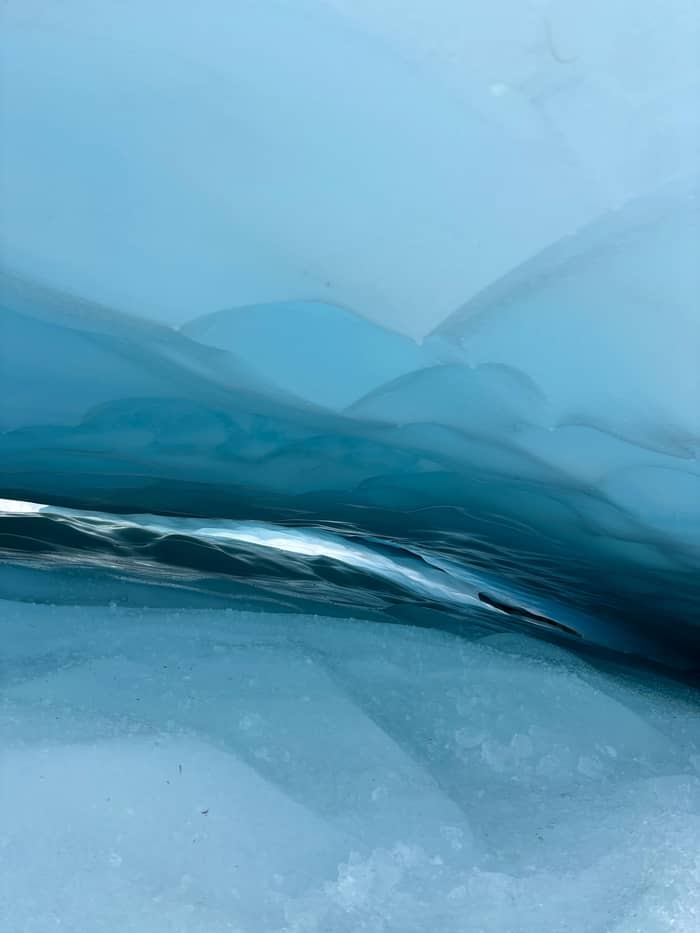
Shorts possible
Summer sun on the ice
Long days, bright light
Plan my kitPacking and prep checklist
Fast answer
On a Fox Glacier heli hike you wear 3-4 warm layers under a waterproof jacket and overtrousers the guides supply, and the guide fits crampons on the ice.
Kit essentials
List of 10 items
Tick items as you finish them. We save your progress on this device.
0 / 10 ready
All done. Only the booking is left: your morning on the ice.
Secure your spotWhat to wear on a Fox Glacier heli hike comes down to layers, because the guides supply boots, crampons and a rain shell. This page sorts what is supplied, what to pack and what to leave behind.
Editorial team, foxglacierhelihike.top · Updated November 6, 2026 · A 7 min read
The essentials
Fox Glacier Guiding says that on its Flying Fox heli hike it provides leather boots, socks, crampons, walking poles, a waterproof jacket, overtrousers, hat and gloves, plus a backpack.1 That list covers the heavy, technical and wet-weather kit, which is why the packing question on this page is mostly about what goes underneath the shell, and about what stays out of the helicopter altogether.
The order of events matters, because boots and crampons are not put on at the same time. Guests are equipped with leather walking boots before they board the helicopter for the first flight over the lower icefall.6 The spikes come later: at the landing site on the ice, the guide fits crampons designed for the ice conditions, and everyone follows the ice steps the guide cuts.7
Crampons are simply steel spikes that clip under a boot so that it bites into ice. The operator's page for its all-day trip describes them as ice-hiking spikes, and says guests put them on after landing, before walking the steep upper icefall.8 Since both are issued, there is nothing to buy or rent in the village, and nothing to break in. Ask your guide before layering your own socks inside the boots. A walk on Fox Glacier is, in the end, a walk in borrowed boots.
Who sorts what
| Item | Who sorts it | When it goes on |
|---|---|---|
| Leather boots | Operator | Fitted before the flight6 |
| Crampons | Operator | Fitted at the landing site7 |
| Jacket and overtrousers | Operator | Waterproof, supplied1 |
| Hat and gloves | Operator | Supplied1 |
| 3-4 warm layers | You | Worn from the village2 |
| Sunglasses, sun cream | You | Essential16 |
| Essential medication | You | In your small pack17 |
| Jeans | Not advised | Heavy and cold when wet13 |
| Drone | Not allowed | Fine of NZ$5,00018 |
| Portable charger | Not allowed | Leave in the car3 |
The table restates the operator's own pages for its Flying Fox heli hike; kit can differ between trips, so check your booking.
The operator asks for 3-4 upper layers, with a light shirt, a long sleeve fleece and a wind-breaker given as examples.12 Its heli hike page repeats the same count in the list of things to bring, next to essential medication, sunglasses, sun protection, a drink, snacks and a camera.2 A thin base layer, a fleece and a wind-proof outer is one way to read that, and it lets you add or shed a layer when the cloud moves.
Legs need less thought. The operator does not recommend jeans because they become very heavy, cold and uncomfortable when wet; track pants or long cotton pants are best, and shorts suit the summer months.13 Overtrousers are issued as well, so your legs get a waterproof layer on top of whatever you wear, which is why a pair of light, stretchy trousers is the easy choice.1
Guests who went in summer and described it afterwards say a merino layer plus one thicker layer was enough, and that the jacket handed out on the day was not insulated. That fits the operator's own safety net: if you feel you do not have enough warm clothing on the day, the guide can supply a fleece jacket at no extra charge.14 Mention it at check-in, not on the ice, when the helicopter is already waiting.
West Coast weather changes quickly. The operator says New Zealand weather is noted for delivering four seasons in one day at any time of the year, and asks guests to dress with that in mind.20 It also says the temperature at Fox Glacier can vary between 0-25 degrees Celsius, in a region it calls notorious for wild and wet weather.15
On the ice itself the operator reports typical temperatures of +5 to +15 degrees Celsius in summer and -5 to +10 degrees Celsius in winter.5 Both ranges depend on the day, so read them as a spread, not a forecast. A neighbouring operator, Franz Josef Glacier Guides, adds that from April to November the ice can be eight to ten degrees cooler than Franz Josef township, with wind chill making it feel colder still.21
No weather station sits on the glacier. The nearest long NOAA record is Hokitika Aerodrome, a coastal airport 114 km away, so it describes the coast and never the ice.22 Its average daily high is 11.7 °C in July and 21.2 °C in January.22,22 Use the figures only to see how far the seasons swing, and take the operator's ice temperatures for the actual dressing decision.
Match your packing
Pick the line closest to your plan, and the answer sits beside it
If I only own jeans and a cotton hoodie
Borrow or buy track pants
Jeans get heavy, cold and uncomfortable when wet, and track pants are preferred.13
If I run cold and worry about the wind
Add a fleece and ask
The guide can supply a fleece jacket at no extra charge if you are short.14
If I want to film the whole day
Pack light and charge first
Portable chargers are not allowed and the bag limit is 3 kg.3,4
If I am visiting in midsummer
Bring sun cream first
Sunglasses and sun protection are essential, and shorts suit summer.16,13
If I take daily medication
Pack extra in the pack
Guests must bring any medication they might need overnight.17
Three kinds of day
Shorts possible
Long days, bright light
Plan my kit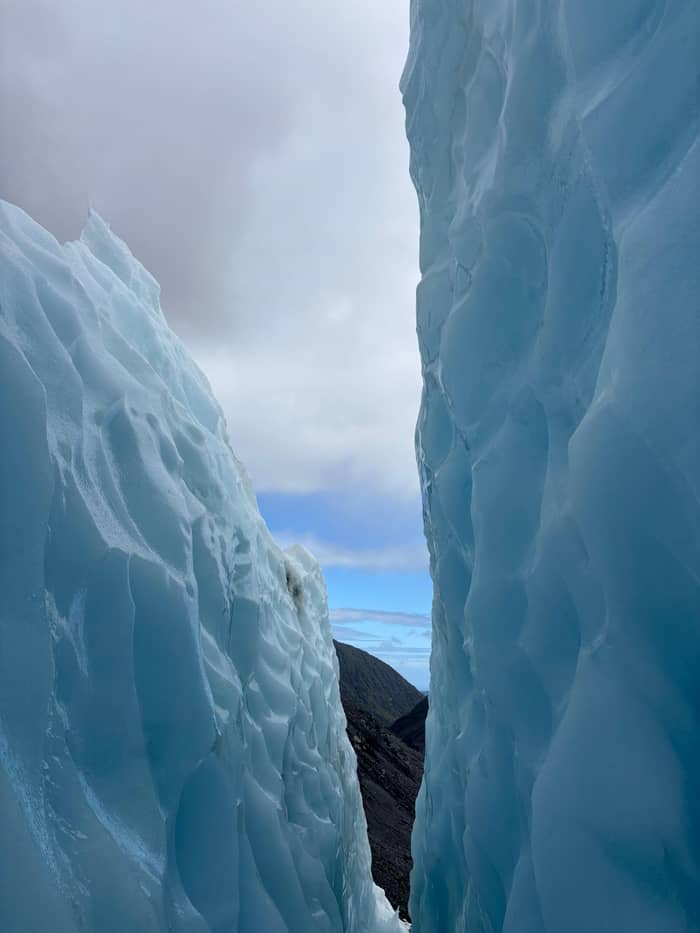
Add layers
Cold, quiet, clear
Plan my kit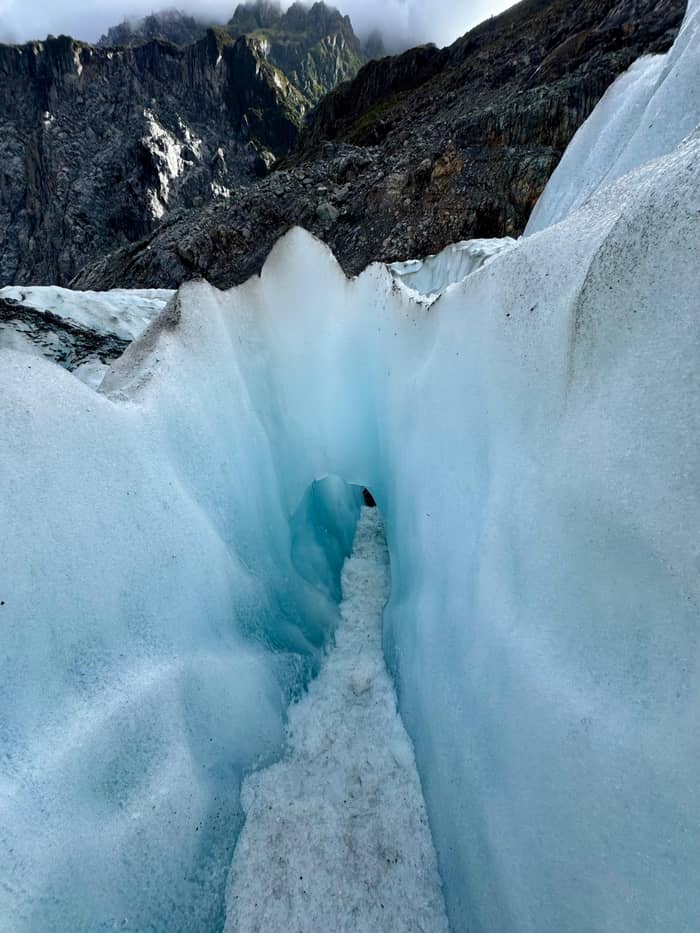
Waterproofs
Cloud low, rain about
Plan my kitThe operator states that sunglasses and sun protection are essential on the heli hike.16 That is easy to underrate on a day that looks overcast from the village. Ice and snow throw light upward as well as down, so skin under the chin, behind the ears and around the nose catches sun that a hat brim does not stop. Apply sunscreen before you leave the village, not after the flight.
A hat and gloves are supplied, so you do not need to bring heavy ones.1 What you may want instead are a thin pair of liner gloves for handling a camera, and a lip balm with sun protection. Wear sunglasses that stay put on your face, with a strap if you have one, because a pair dropped on the ice is a pair lost to a crevasse or a meltwater channel.
Check-in is 20 minutes before departure, and that short window is a good time to deal with the last of it: sunscreen, a final layer, a drink.9 The tour of this site runs 4 hours in total and starts at the guiding base on the Main Road of the village, so none of this has to be done in a hurry. Arrive dressed for the glacier, not for the car park.
From the base to the ice
20 min before
Check-in is 20 minutes before departure, at the building on the Main Road.9,10
Before the flight
Guests are equipped with leather walking boots before boarding the helicopter.6
In the air
The helicopter flies over the lower icefall before landing on a remote part of the glacier.6
At the landing site
The guide fits crampons designed for the ice conditions, then leads along cut ice steps.7
On the ice
Weather permitting, ice time is up to 3 hours on the Flying Fox heli hike.11
The operator's what-not-to-bring list names drones, valuable items, portable chargers and spare batteries, your own backpack, and vapes, e-cigarettes, cigarettes and lighters.3 Several of these are a surprise to phone-dependent travellers, so charge your phone fully in the morning, and keep any power bank in the car or at your accommodation.
A small pack is issued, and each passenger may carry at most 3 kg of carry-on baggage, with a camera, a snack, a water bottle and an extra layer suggested by the operator.4 Treat that as a hard cap when you pack: weigh the camera, the lens and the water in your hand before you drive to the base, and leave a second lens in the car if it pushes you over.
Drones are the one item with a penalty attached. Flying a drone at Fox Glacier is illegal because it is inside a National Park, and the operator says a drone will be confiscated and the owner fined NZ$5,000.18 Leave it at home. For wallets, passports and keys, ask at the base what is sensible to carry; the operator lists valuable items under what not to bring.3
Video
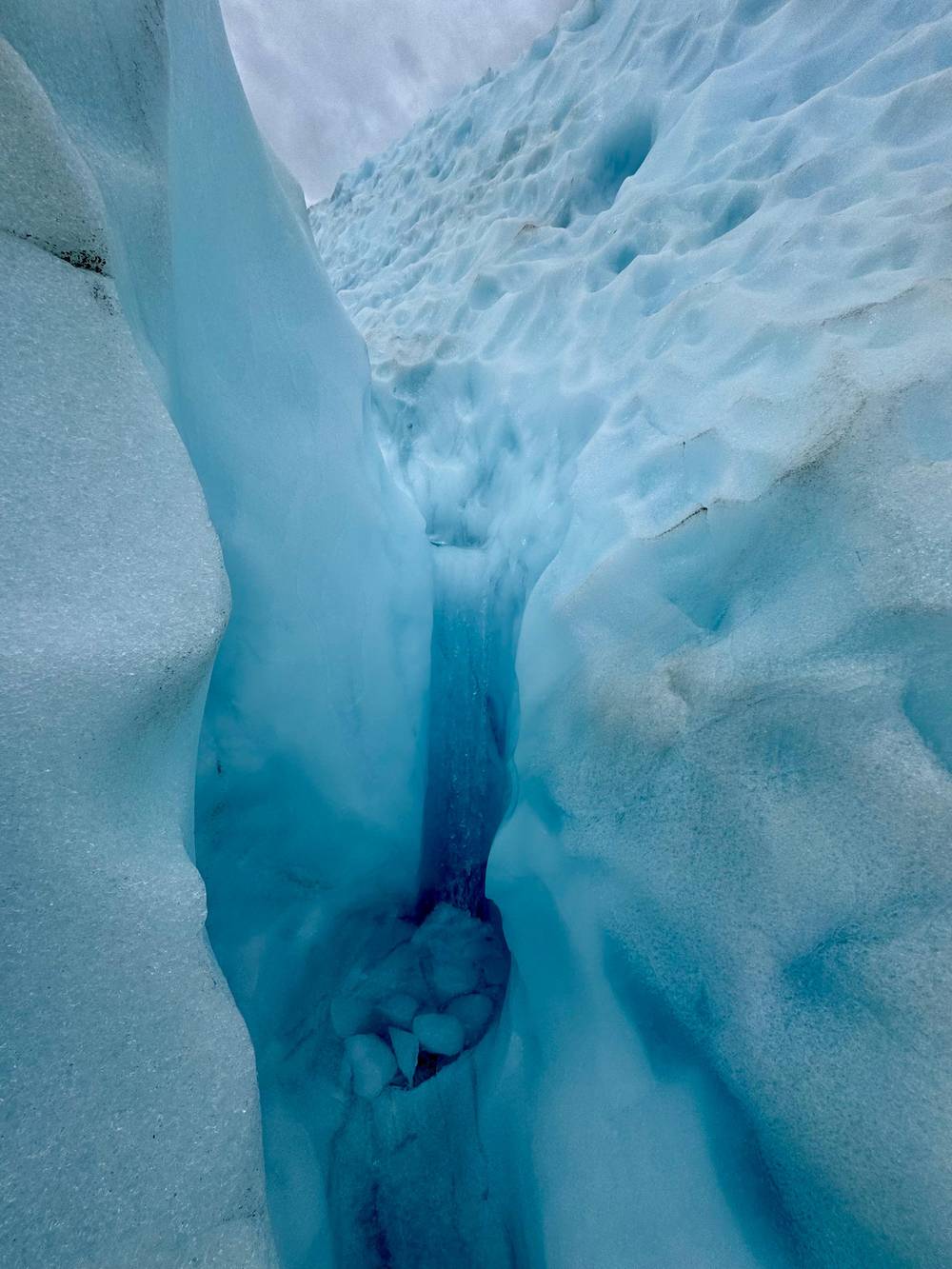
Chris Gault on YouTube · Video data is requested only when you tap play.
Jeans are not recommended for our trips as they become very heavy, cold and uncomfortable to wear when wet.
Ice time is up to 3 hours, weather permitting, and the operator gives no guarantee that specific ice features will be seen.11 A drink and a snack are listed as useful, and they matter more than they sound once you are standing on ice for most of a morning.2 Pack something small that can be eaten with gloves on, and drink before you board, not just on the glacier.
The operator also asks guests to bring any medication they might need overnight, in case time on the ice is extended.17 That sounds dramatic, but it is a plain safety measure: if helicopters cannot reach a group, the operator keeps emergency supplies on the glacier, including tents, sleeping bags, roll mats and food, and its guides are trained to set up a camp for the night.23
One guest in the review digest said that advice was news to them, which is the reason to read the booking confirmation again the night before. Add the medication to your small pack with the camera and snack. If you take something that must be refrigerated or timed, talk to the base staff first, and ask what the guide would do if the trip ran long.
Some mornings the cloud sits too low to fly. The operator makes its final weather decision for each trip 10 minutes before departure, so you will not know until you are at the base.24 Packing one dry change of clothes in the car turns a cancelled flight into a plain valley walk with no fuss, and a rebooked slot into a second try.
The valley walk calls for a different kit. Glacier Country advises always taking warm and waterproof clothing for walks here, because the weather can change rapidly, along with drinking water, insect repellent and sun protection.25 Waterproof shoes with grip are worth more on the valley track than any fleece, because the track passes through rainforest and over damp moraine.
The Department of Conservation notes that Westland Tai Poutini National Park lies in the path of the prevailing westerly winds, which can bring heavy rain at any time of the year, with up to five metres falling annually.19 So a rain shell belongs in the car every day of the stay, even when the heli hike is booked for a sunny forecast and the shell is supplied on the glacier.
FAQ
The operator does not recommend jeans because they become very heavy, cold and uncomfortable when wet.13
A light shirt, a long sleeve fleece and a wind-breaker are the operator's examples of the 3-4 layers it recommends.12
The operator reports typically +5 to +15 degrees Celsius in summer and -5 to +10 degrees Celsius in winter.5
The operator lists portable chargers and spare batteries under what not to bring.3
They appear in the operator's list of supplied kit, together with boots, crampons and a waterproof jacket.1
The operator allows 3 kg of carry-on baggage per passenger and suggests a camera, a snack, a water bottle and an extra layer.4
The operator says sunglasses and sun protection are essential on the heli hike.16
Sources
Next read
Wondering if the Fox Glacier heli hike suits you? A real person answers here.